Mobile-first digital publication: is your catalog really readable on a smartphone?
Over 60% of web content consumption happens on mobile. Why mobile-first design changes everything for your digital publications.
 By Jules Bailleul 19 May 2026 5 min read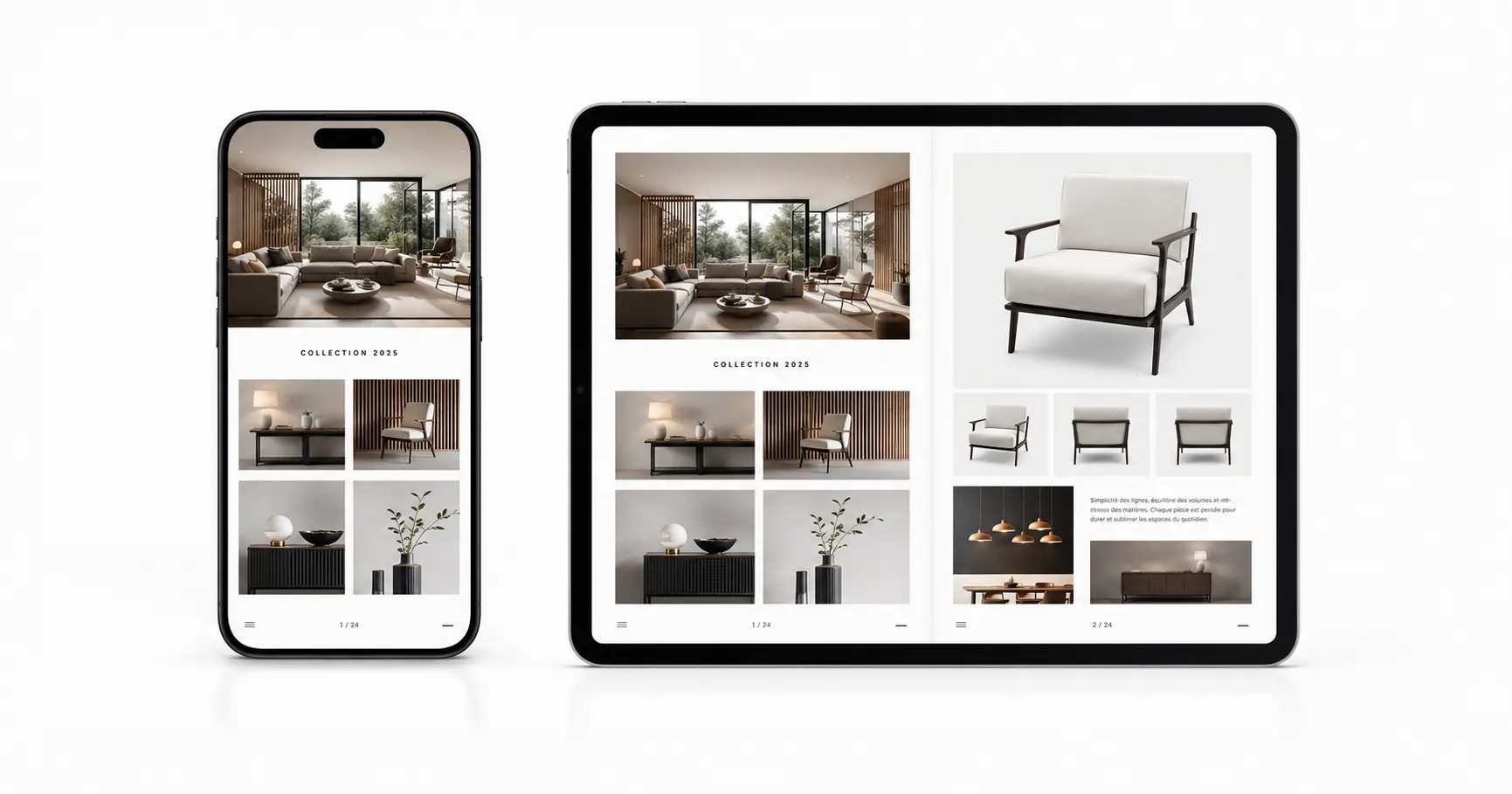
Your catalog is available online. Your readers can access it from your website, your newsletter, or a link shared on social media. You have taken the digital step. Good.
But here is the question that really matters: how does your catalog display on a 6-inch screen?
In 2025, more than 60% of web content consumption happens on mobile. For B2C publications, this figure climbs even higher in certain sectors. If your digital publication is not designed for smartphones, you lose the majority of your audience before they even start reading.
The problem of PDFs uploaded online
The most widespread solution to digitize a catalog still today is to take the PDF file of the printed version and upload it online, sometimes via a simple flipbook tool.
The result on mobile is often catastrophic. The user lands on an A4 or A3 page designed to be printed and held at arm's length. They see illegible text at that size, zoom in, lose their place, zoom out, search again. After 30 seconds, they close.
"Your catalog has been opened. It counts in your statistics. But it has not been read."
What mobile-first really means for a publication
A mobile-first native digital publication is not a PDF that has been adapted. It is a publication designed from the start to function on every device, with different editorial and technical choices.
Mobile-first criteria
- 01Text legibility without zoomYour body text must be readable at the native screen size, without the reader having to pinch to zoom. This requires larger type sizes and a rethought visual hierarchy.
- 02Gesture-based navigationOn mobile, you swipe, tap, slide. Interactions must be designed for fingers, not the mouse. Tappable areas must be wide enough to be activated without surgical precision.
- 03Fast loadingA smartphone reader is often on the move, on a variable 4G or 5G connection. A publication that is too heavy displays blank for several seconds. The reader does not wait.
- 04Adaptive layoutDepending on whether the reader is on a 5-inch smartphone or an 11-inch tablet, the layout adjusts automatically. A desktop double-page becomes two distinct pages on mobile, without losing editorial coherence.
What data reveals about mobile behaviors
Prestimedia publications that include analytics tracking reveal very different behaviors depending on the device type.
Desktop readers spend on average more time per session but on fewer pages. Mobile readers often consult from a notification or a share, with shorter but more frequent attention: they return several times to the same publication.
Ignoring mobile means ignoring consumption behaviors that have their own logic and their own commercial value. It also means missing the interactivity that turns interest into a purchase.
The professional dimension
In B2B, one might think that mobile is less critical: professional buyers consult from their desk, on their computer. This intuition is less and less true.
B2B catalogs are shared by email, transmitted via professional messaging applications, consulted in meetings from a tablet or while traveling from a smartphone. A B2B catalog that is not mobile-friendly misses a growing share of its consultation moments.
What Prestimedia proposes on this point
The mobile-first version is an option we offer as a complement to the standard desktop publication. It consists of creating a version specifically designed for smartphones, in parallel with the main version — with a redesigned layout, gesture-based navigation, and optimized loading times.
It is not automatic: it is an editorial and budgetary choice that we discuss with each client according to their audience, distribution channels, and objectives. For brands whose readers mostly consult on mobile, it is often the most profitable investment of the publication.
Would you like to know if your audience justifies a mobile-first version? This is one of the first questions we ask during a diagnosis.